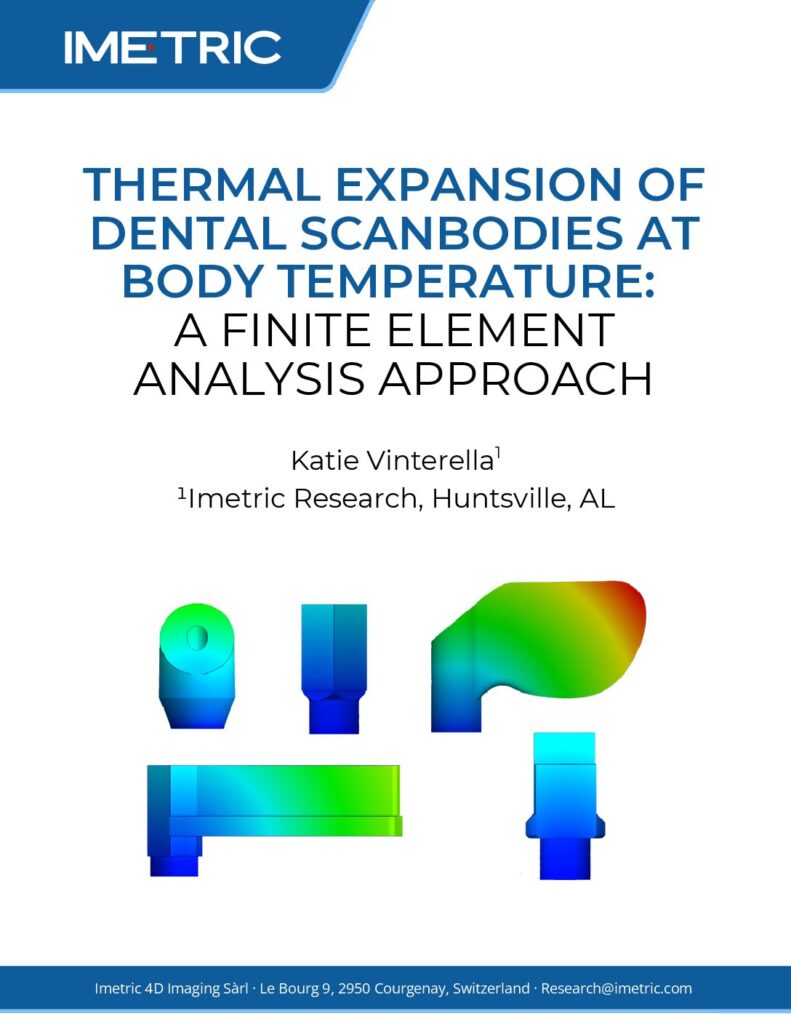
When objects are exposed to a temperature change they experience a change in size, a phenomenon known as thermal expansion. In implant dentistry, factoring in that effect is important to maintain the accuracy required for a successful full-arch case. Dental scanbodies are frequently exposed to temperature changes during daily use, both when placed in a patient’s mouth during measurement and when sterilized in an autoclave. This study used finite element analysis (FEA) to simulate the thermal expansion of various dental scanbodies when exposed to the environment of the patient’s mouth.
Expansion is proportional to both the length of the object and its coefficient of linear thermal expansion (CTE), an intrinsic property of the material. The CTE of aluminum alloy is 2.7 times larger than that of titanium alloy (Ti-6Al-4V), and the CTE of polyether ether ketone (PEEK) is 4.4 times larger. A larger scanbody, or one made from PEEK, will therefore expand more than a smaller titanium one under the same conditions. Scanbodies were reverse-engineered in SOLIDWORKS 2023 and simulated in SOLIDWORKS Simulation at timestamps of 90 and 480 seconds.
Even at body temperature for a relatively short period of time, 90 seconds, scanbodies showed a maximum resultant displacement ranging from 4 to 11 µm under nominal ambient conditions. After reaching thermal equilibrium, those values increased to 4 to 14 µm. Scanbodies longer than 16 mm, and those made from PEEK, deformed the most. The ICamBody experienced the least expansion at both timestamps, 43 to 71% less than scanbodies that were larger or made from PEEK, owing to its comparatively small length and its use of aluminum and titanium alloys.
The clinical thermal environment alone introduced 1 to 11 µm of expansion across the range of airflow conditions analyzed. Because some scanbodies expand by as much as 13 µm at body temperature, it is reasonable to assume their scan targets have shifted from their factory-calibrated positions, which can increase measurement error for devices that are not routinely calibrated before use. Based on these results, dental scanbody design can be optimized by maintaining a small overall size and using materials with lower CTE values.